
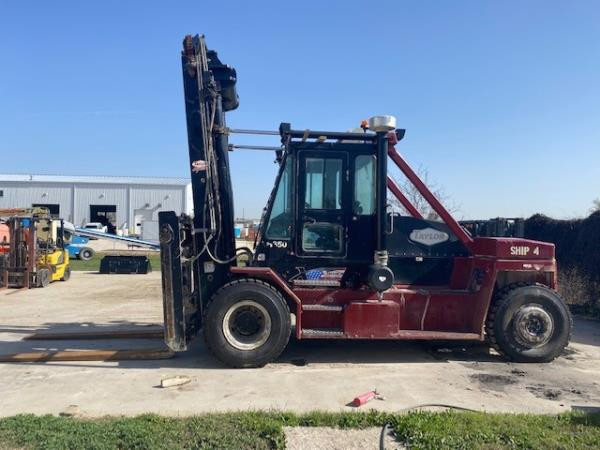



The forklift's turning radius is also called the turning circle, which is important information for the operator to have. It gives the driver the knowledge of how much space is required to turn the forklift around. For example, a tighter turning radius allows the equipment to successfully work in crowded areas and restricted places, thus improving the maneuverability of the lift truck. Operators who do not know this measurement could cause damage to the property or to the machinery.
Before checking the turning radius, check the steering geometry alignment and correct it if it needs adjustment. Start the test with having the trained operator inside the cab to control the machine's functions. Another individual on the ground uses a hose or a spray bottle to wet the outside and inside of the unit's wheels. Next, drive the machinery in a complete circle with the wheels turned to the maximum angle. Repeat the procedure once and continue if necessary to wet the wheels.
After this measurement test has been completed, measure the watermarks left by the tires utilizing a tape measure, from the midpoint of the tire mark to a similar point across the circle's diameter. For the outside turning diameter, measure the watermark left by the exterior tires from one side of the circle to the opposite side of the circle. The inside turning diameter can be determined by stretching the tape measure across the circle left by the interior tires. After that, divide these numbers in 2 to be able to establish the turning radius. Be certain to note that the turning center is the midpoint of the diameter of the circle.
Drop a plumb line from the extreme outside radial extension on the equipment in order to establish the wall-to-wall turning diameter. When this is done, next find the point on the pavement directly underneath. This point to the turning center indicates the clearance radius of the machine. As a rule, wall-to-wall turning diameter is twice the clearance radius of the machinery.